
Introduction
Web hosting: This guide is a friendly chat about it, especially if you’re just getting started. It leads you through what hosting actually is, how it works, and the main options you have, all with practical examples that relate to local businesses and everyday website needs. What we’ve discovered is that keeping things simple and using clear explanations and familiar analogies makes it easier to understand how to set up a website or give an existing one a boost without getting lost in complicated tech jargon.
Sections focus on:
- Understanding the purpose of web hosting and why it matters for accessibility and speed
- The main hosting options and how to choose the right type
- The practical upgrade path from basic to more capable plans
- Local considerations for Nepal, including latency and regional support

Web hosting is the home where a website lives on the internet. It stores files, serves pages to visitors, and provides the technical resources that keep a site online. In practical terms, hosting serves as the foundation that enables fast loading for users in Nepal and beyond.
For Nepali users, choosing the right host affects:
- Page load speed for local visitors
- Availability during peak traffic times such as Dashain and exam seasons
- Access to local support and easy management tools
Selecting appropriate hosting is a foundational step that supports growth, reliability, and user experience as a website expands from a simple blog to a robust online presence.
1. What Web Hosting Really Is
Definition of web hosting
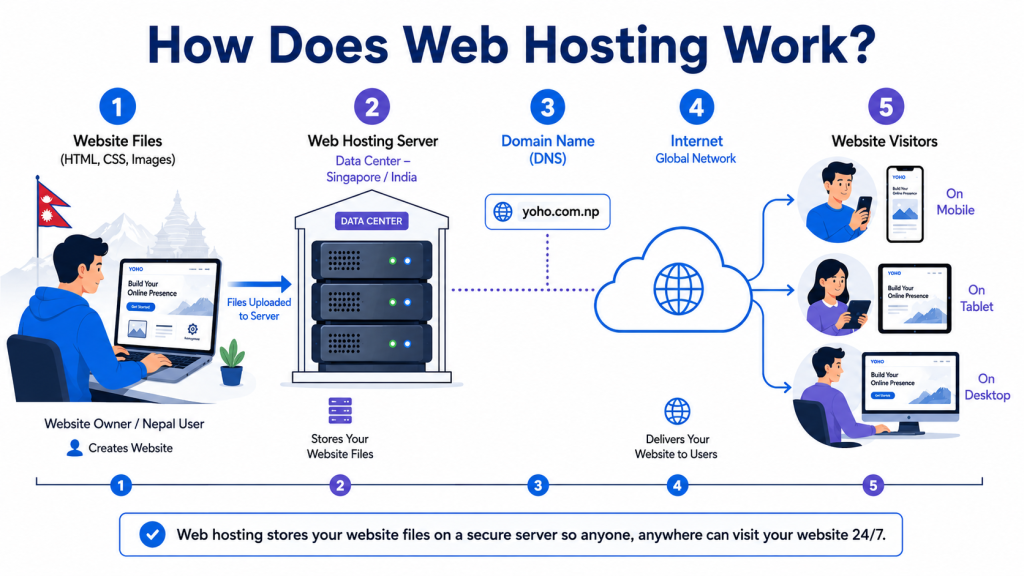
Web hosting is a service that provides the space, technology, and support needed to publish a website on the internet. It involves storing website files on a server and making them accessible to visitors whenever they request the site. Practically, hosting is the platform that keeps pages reachable and properly formatted for users in Nepal and around the world.
For beginners, hosting can be viewed as the land and infrastructure where a website resides. The hosting provider manages the server, network connectivity, and software required to serve pages, while you focus on content and design.
Why hosting matters for website accessibility
Website accessibility depends on the hosting setup. If the server is slow or offline, pages load slowly or fail to load. A reliable host helps ensure assets load quickly, even during higher traffic periods common in Nepal, such as festival seasons or exam periods.
Key accessibility factors include the following:
- Server uptime: the percentage of time the site is online
- Network speed: how quickly data travels from the server to the user
- Geographic proximity: closer servers can reduce latency for local visitors
- Local hosting options can improve response times for Nepal-based users
- Managed support helps resolve issues promptly, minimizing downtime
- Quality hosting aligns with long-term growth plans and content strategy
2. How Web Hosting Works
The role of servers, storage, and bandwidth
Web hosting relies on three core components that work together to make a website accessible. Servers store website files and respond to requests from visitors, while storage indicates where those files are kept, often on fast solid-state drives or similar media.
Bandwidth determines how much data can be transmitted to visitors over the internet in a given period. For Nepal, selecting a hosting plan with adequate bandwidth helps ensure page load smoothly during local peak periods.
Understanding these elements supports performance evaluation. A faster server responds more quickly to requests, sufficient storage accommodates growing content, and ample bandwidth sustains multiple visitors loading images, videos, and interactive features simultaneously. Local providers may tailor these components to regional networks, improving the overall experience for nearby users.
From domain to page load: the flow of a web request
The journey from entering a website address to viewing a page on the screen involves several steps. First, the browser queries a domain name system (DNS) server to translate the domain into an IP address. Next, the browser connects to the hosting server identified by that address. The server processes the request, retrieves the correct files, and sends them back over the network. Finally, the browser renders the page for the user.
During this flow, caching and content delivery mechanisms can influence speed. Local caching reduces repeated data transfer, while a content delivery network distributes static assets closer to users. For Nepali sites, optimizing DNS responsiveness and leveraging regional caches can reduce initial load times for local visitors.
3. Key Hosting Types for Beginners
Shared hosting: best for starters
Shared hosting offers an affordable entry point for new websites. In this setup, multiple sites share a single server and its resources, which keeps costs low.
For Nepali beginners, shared hosting provides a straightforward control panel and simple setup processes. It is suitable for personal blogs, small business sites, and basic portfolios during the initial growth phase.
VPS hosting: balance of control and cost
Virtual Private Server (VPS) hosting allocates dedicated virtual resources within a shared server. This arrangement provides more predictable performance than shared hosting while remaining cost-effective.
VPS is a good fit for growing businesses that require stricter resource control, such as moderate traffic, custom software, or specific software versions. It offers root access for configuration without the expense of a full dedicated server.
WordPress hosting: optimized for a CMS
WordPress hosting is customized for WordPress sites. It usually provides ready-to-go WordPress setups, automatic updates, and performance optimizations.
For Nepali users, this type reduces maintenance effort and accelerates site deployment, especially for blogs, local news portals, and small e-commerce shops that rely on WordPress plugins and themes.
Managed hosting: hands-off convenience
Managed hosting shifts routine administration to the provider. This encompasses updates, security monitoring, backups, and sometimes content migration support.
Small businesses in Nepal benefit from reduced technical workload, faster issue resolution, and predictable monthly costs. Managed options are advantageous when the focus is on content and growth rather than server management.
- Shared hosting: lowest cost, simplest setup
- VPS hosting: scalable performance with more control
- WordPress hosting: CMS-optimized for speed and reliability
- Managed hosting: comprehensive care with minimal admin effort
4. Choosing the Right Hosting Plan
Selecting a hosting plan requires a practical view of current needs and anticipated growth. For Nepali users, it is important to balance affordability with reliability, ensuring the site remains accessible during local traffic peaks. This section outlines a clear framework to guide that decision.
Assessing traffic, resources, and growth
Begin with a realistic traffic forecast based on your current visitors and expected changes during seasonal events. Consider resources like storage, RAM, and CPU, and plan for gradual scaling to avoid performance bottlenecks. A well-chosen plan should allow you to upgrade without significant downtime.
- Estimate monthly visitors and expected page views per visit
- Choose a plan with headroom for peak periods, such as festival seasons
- Prefer plans that offer easy vertical scaling or quick migration paths
Security, backups, and uptime considerations
Security features protect a site from threats and data loss. Look for automated backups, SSL availability, malware scans, and DDoS protection. Uptime guarantees indicate the provider’s commitment to service availability, and a solid backup strategy minimizes recovery time after incidents.
- Automated daily or near-daily backups with recovery options
- SSL certificates included or easy to enable
- Transparent uptime commitments and maintenance windows
Support and ease of use
Local or regional support matters for quick resolution of Nepali-specific issues. A user-friendly control panel, clear migration assistance, and responsive helpdesk reduce setup time and ongoing management effort.
- Local phone or chat support during Nepal business hours
- Intuitive control panels such as cPanel or DirectAdmin
- Migration assistance with minimal downtime
Platform features to look for (NVMe, PHP versions, migrations)
Key platform capabilities influence site speed and compatibility. NVMe storage improves I/O performance; up-to-date PHP versions ensure better security and efficiency; seamless migrations protect existing content during transitions.
| Feature | Why it matters for Nepal | What to verify |
| NVMe storage | Faster data access improves page load times for local users | Check if NVMe is included and whether caching is supported |
| PHP versions | Modern sites benefit from current security and performance optimizations | Confirm supported PHP versions and easy version switching |
| Migrations | A smooth transfer reduces downtime and risk | Look for free or guided migration services and rollback options |
5. Hosting for Local Markets: Why Nepal-Based Providers Matter
For Nepal-based websites, selecting a hosting provider with a local presence can translate into tangible performance and support advantages. Local providers understand regional internet patterns, regulatory requirements, and business hours that align with Nepali operations. This section highlights why Nepal-focused services deserve strong consideration when building a web presence for the local market.
Local latency and optimization
Data requests traveling shorter physical distances can reduce latency, improving page load times for visitors within Nepal. Local hosts often implement infrastructure optimizations tailored to regional network paths, which can yield more consistent performance during peak local traffic periods. This approach supports faster storefronts, news portals, and educational platforms serving Nepali audiences.
Regional support and data handling
Regional support is typically more accessible for urgent issues, with language familiarity and business-hour alignment that suit Nepal-based teams. Data handling practices may reflect national expectations, including compliance considerations relevant to local customers. Faster issue resolution and smoother content updates contribute to steadier uptime and user trust.
Prabhu Host: what it offers for Nepal-based websites
| Offering | Relevance for Nepal | What to verify |
| Local data centers | Improved latency for Nepali users and reduced cross-border traffic | Check available Nepal-based data center locations |
| Customer support | Timely assistance during local business hours in Nepali or English | Confirm response times and support channels |
| Pricing and plans tailored to local market | Cost structure aligned with local budgets and currency considerations | Review renewal rates and any regional promotions |
In summary, Nepal-based providers can offer measurable benefits in speed, support quality, and cost suitability for regional websites. Evaluating local options alongside global services helps ensure a balanced, resilient hosting strategy for Nepal’s evolving online ecosystem.
6. Core Features to Look for in a Host
Performance features: NVMe SSDs and caching
For Nepali websites, fast data access translates to a better user experience across local networks. Look for hosts that offer NVMe storage, which provides lower latency and higher IOPS compared to standard SSDs. A robust caching layer further reduces page load times during traffic spikes.
- NVMe storage as standard or optional
- Integrated caching mechanisms such as LiteSpeed or equivalent
- Clear guidance on caching configuration for CMSs like WordPress
Security features: backups, SSL, malware scanning
Security should be embedded in the hosting plan from the outset. Ensure automated backups, preferably with daily restore points, and SSL certificates to encrypt data in transit. Ongoing malware scanning and remediation support help protect Nepali users and preserve site integrity.
- Automated daily backups and restore options
- Free or affordable SSL certificates
- Active malware scanning and remediation support
Reliability: uptime guarantees and redundancy
Uptime influences trust and revenue. Evaluate the provider’s uptime commitments and the level of redundancy, including multiple data paths, failover systems, and maintenance practices that minimize impact on visitors in Nepal.
- Explicit uptime guarantees
- Redundant network connections and power supply
- Transparent maintenance schedules and notification practices
Convenience: migrations and automated backups
Reducing setup effort enables faster deployment. Seek hosts offering complimentary migrations with guided processes and automated daily backups that minimize manual intervention.
- Complimentary migration services
- One-click staging environments for testing
- Intuitive control panels with clear migration workflows
The Setup Process: From Sign-Up to Live
Setting up a hosting account in Nepal should be straightforward and predictable. This section outlines a clear path from choosing a plan to having your site reachable by visitors, with an emphasis on local considerations and a smooth transition for beginners.
Registering a domain and selecting a plan
Begin with a domain that reflects your brand and is easy for Nepali users to recall. Most providers offer a simple search tool to check availability and suggest close alternatives. When selecting a plan, assess current traffic, growth potential, and the types of content you will publish. Local providers often offer plans aligned with Nepalese budgets and currencies.
- Choose a domain with a simple, memorable name
- Match plan resources to expected traffic and content type
- Check renewal pricing and any included perks such as free SSL or backups
Migrating an existing site with ease
For sites migrating from another host, choose a provider that offers guided migration. This typically includes a transfer window, CMS compatibility checks, and a rollback option if needed. Plan for a minimal downtime window during the move to maintain accessibility for Nepali visitors.
- Request a guided migration service if available
- Prepare CMS credentials, databases, and media folders
- Test the site on a staging environment before going live
Connecting domains and going live
After migration, point your domain to the new server by updating DNS records. This step may involve adjusting A records or nameserver settings. Once propagation completes, perform a final check for links, forms, and email functionality to ensure a seamless user experience for Nepal-based visitors.
| Step | What to verify | Typical timeframe |
| Domain registration | The domain name resolves to the hosting provider | Hours to a day |
| Migration | Content, databases, and media intact | Same day to 48 hours |
| DNS propagation | The site loads from new server across Nepal | Up to 48 hours |
| Step | What to verify | Typical timeframe |
| Domain registration | The domain name resolves to the hosting provider | Hours to a day |
| Migration | Content, databases, and media intact | Same day to 48 hours |
| DNS propagation | The site loads from new server across Nepal | Up to 48 hours |
FAQ
What is the difference between domain and web hosting?
A domain is the address of your website on the internet, such as example.com. Web hosting provides the space, technology, and support needed to publish and serve your site to visitors. In simple terms, the domain directs users to your site, while hosting delivers the site content.
Do I need an SSL certificate?
Yes. An SSL certificate encrypts data in transit between users and the server, indicated by the padlock in browsers. It protects login credentials, payment details, and other sensitive information. Some hosts include SSL at no extra cost, while others offer it as a paid option.
Can I transfer my existing website to a new host?
Yes. Migration typically involves moving files, databases, and emails to the new server. Many providers offer guided migration or one-click tools to simplify the process. Plan for a testing window to verify functionality before going live.
What is an uptime guarantee?
An uptime guarantee specifies the minimum time the service is available to visitors. A higher percentage indicates greater reliability, and some providers offer credits if availability falls below the stated level. Look for clear terms and transparent monitoring.
What does managed WordPress hosting mean?
Managed WordPress hosting means the provider handles WordPress-specific maintenance, including core updates, security patches, backups, and performance optimization. This reduces technical tasks for beginners and can improve site reliability and speed.
| Question | Key point | What to look for |
| Domain vs hosting | Domain = address; hosting = where files live | Clear separation in pricing and controls |
| SSL certificate | Encrypts data in transit | Included or affordable; easy activation |
| Website migration | Transferring files and databases | Guided migration options and testing phase |
| Uptime guarantee | Availability level and credits policy | Transparent terms and monitoring details |
| Managed WordPress | The provider handles WordPress-specific maintenance | Scope of management and performance benefits |
Conclusion
Choosing the right hosting plan is a decision that impacts reliability, speed, and growth. For Nepali beginners, focusing on local support, predictable pricing, and essential features provides a solid foundation for a successful online presence.
Key takeaways for the upgrade journey and common mistakes include a clear emphasis on practicality over price alone, awareness of regional considerations, and a staged approach to scaling as traffic rises. This contributes to a smoother transition from basic to more capable hosting environments without compromising user experience.
- Prioritize local support and latency considerations to ensure responsive performance for Nepal-based visitors.
- Plan for growth with scalable resources and clear upgrade milestones tied to traffic and functionality needs.
- Avoid common pitfalls such as neglecting uptime implications, underestimating backup requirements, and insufficient migration planning.
Yoho Cloud offers foundations that align with these principles, supporting Nepal-hosted sites through practical options, straightforward migrations, and reliable service levels. The focus remains on clarity, accessibility, and a transparent upgrade path that accommodates seasonal and regional traffic shifts.