Introduction
AI web hosting is a modern type of web hosting that uses artificial intelligence to automatically manage, optimize, and secure websites without needing constant human intervention. AI web hosting helps businesses run faster, safer, and more efficiently, making it especially useful for modern websites, eCommerce, and AI-powered tools. Web hosting isn’t what it used to be, and that’s a good thing.
With the rise of artificial intelligence (AI), the industry is going through a major shift. What once required constant manual work and technical expertise is now becoming smarter, faster, and much easier to manage. Artificial intelligence has shifted from an optional functionality to a basic component, which is causing a significant change in the web hosting industry. Instead of being limited to chatbots or site builders, AI-supported hosting now includes end-to-end infrastructure management, such as DNS setting, security monitoring, and smart recovery.
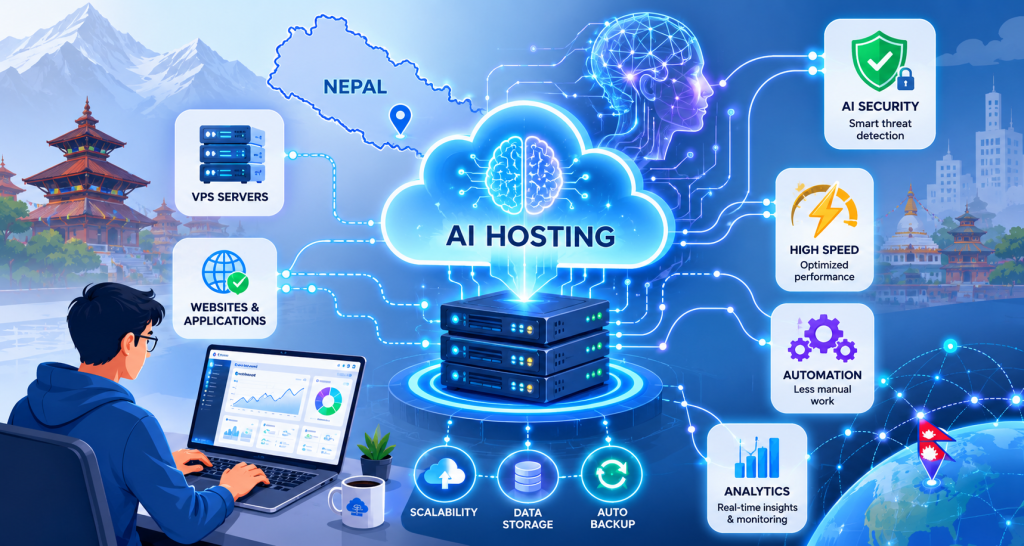
Behind the scenes right now, AI is helping websites run smoothly, stay safe, and manage traffic more efficiently. Whether you’re a small business owner or managing a large online platform, this change is affecting the performance and growth of your website. Including practical considerations for clients in the Nepalese market and neighboring areas, this section describes how AI-based hosting may impact standards of performance, safety, and operations for businesses of various sizes. The overview provides a clear point of view for evaluating intelligent hosting solutions by focusing on recent developments in the sector and real-world applications.
Nepalese infrastructure and values
With growing digital demand and evolving connectivity in Nepal, reliable performance, scalable solutions, and responsive support tailored to regional conditions are required. Hosting, ready for AI, addresses these needs by allowing:
Intelligent caching and edge-aware routing for fast content delivery and lower perceived latency for Nepalese users.
Operational efficiency is achieved through automated management layers, enabling local teams to focus on core business activities.
Improved security through early detection of anomalies and fast incident response without a large in-house skillset.
Predictable cost with a scalable, usage-based resource allocation that handles seasonal traffic without manual intervention.
Positioning in this context highlights the promise of platforms that marry AI infrastructure management, for example, AI-native hosting channels and context-aware control surfaces, to offer real value for Nepal and the broader South Asian region.
Growing Demand of VPS
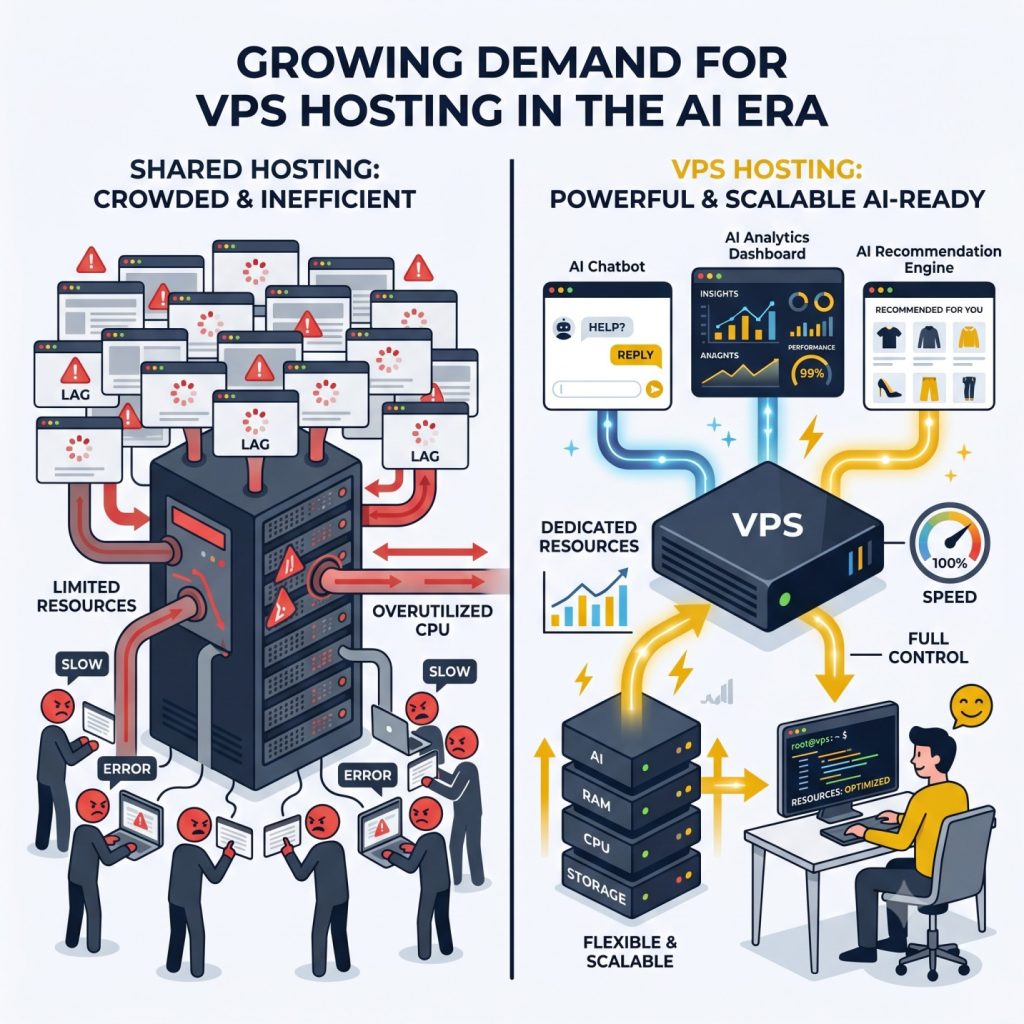
The web hosting landscape has changed dramatically with the rise of artificial intelligence. The demand for virtual private server (VPS) hosting has skyrocketed. With websites and applications getting smarter, more dynamic, and more resource-hungry, traditional shared hosting can’t keep up, and VPS is the preferred choice.
One of the main drivers for this change is performance & scalability. Apps like chatbots, recommendation engines, and real-time analytics tools powered by AI require more processing power and faster response rates. VPS hosting gives you dedicated resources within a virtualized environment, so your performance won’t be affected by anyone else.
Flexibility and control are another important factor. Developers want the flexibility to install custom software, frameworks, and machine learning models with the AI integration. VPS gives you full root access, which makes it easier to configure environments specific to AI workloads, something you can’t do with shared hosting.
AI-Driven Performance Optimization in Hosting
Smart resource allocation and autoscaling
AI-enabled hosting is a new model of dynamic resource management that reacts to demand signals in real time. Smart controllers look at traffic patterns, calculate load and storage I/O and assign CPU, memory, and bandwidth where it is needed most. It avoids over-provisioning while still providing optimal performance during traffic peaks. Automated policies allow scaling resources up and down without manual intervention, providing consistent user experiences and cost efficiencies.
AI-powered autoscaling uses historical usage data and live telemetry to predict demand and start scaling resources up or down gradually before any latency problems occur. This leads to faster response times for time-sensitive sessions and is suitable for workloads with variable needs, such as seasonal e-commerce events or bursts of activity in certain regions. This builds a resilient hosting environment that responds to the rhythms of business, rather than waiting for reactive prompts.
Predictive maintenance and uptime resilience
Predictive analytics in hosting enables proactive maintenance by identifying anomalies before they escalate into incidents. AI models analyze server health metrics, disk I/O trends, and thermal behavior to forecast potential failures, triggering preemptive repairs or workload redistribution. This minimizes unplanned downtime and extends hardware lifecycles through informed scheduling.
Uptime resilience is further enhanced by AI-assisted fault isolation, which pinpoints the root cause of issues across layers such as applications, middleware, and network paths. By contextualizing alerts within a unified data framework, operators can execute targeted remediation without broad, disruptive sweeps. This leads to faster recovery times and a steadier service level for end users.
AI-Powered Security and Threat Detection
Advanced anomaly detection
AI-enabled security systems monitor a broad set of signals, including traffic behavior, login patterns, and resource utilization, to detect deviations from established baselines. By learning typical interaction profiles, these systems can identify subtle irregularities that may signal covert probing, credential stuffing, or insider risk. This approach moves beyond static rule sets and adapts to evolving threat landscapes in real time.
Operationally, anomaly detection informs proactive defense actions such as tightening rate limits, adjusting traffic routes, or introducing additional authentication challenges. The outcome is a more responsive security posture that can differentiate legitimate anomalies from routine spikes, preserving user experience for regional customers.
Automated incident response and recovery
Automation layers coordinate rapid containment actions when a threat is detected. AI-driven workflows can isolate affected segments, throttle suspicious sessions, and redirect traffic to validated endpoints without human intervention. This accelerates mean time to containment and reduces the blast radius of incidents.
Beyond containment, AI supports automated recovery steps such as rolling back compromised configurations, triggering clean backups, and verifying integrity before restoring services. These capabilities help maintain service continuity during cyber events and lessen the workload on security teams, which is especially advantageous for smaller organizations seeking dependable protection without extensive staffing.
AI in User Experience and Automation
Intelligent onboarding and migrations
AI-driven onboarding guides users through a context-aware configuration, analyzing the current hosting environment, CMS choice, and traffic profile to propose sensible defaults for domains, DNS records, and security settings. This approach helps new customers establish a reliable baseline with minimal manual configuration.
During migrations, intelligent helpers assess compatibility, map assets, and execute staged transfers with limited downtime. By identifying potential conflicts and bottlenecks early, the process reduces friction for non-technical owners and accelerates time-to-value. This supports regional businesses transitioning from traditional hosts to AI-ready platforms with fewer operational distractions.
Operational transparency is enhanced through real-time dashboards that present recommended actions in clear language. Users can approve, modify, or override changes, preserving governance while benefiting from automated optimization. This balance between automation and oversight is valuable for Nepalese and regional businesses seeking dependable, user-friendly experiences.
AI-assisted website building and optimization
AI-assisted website building extends beyond initial creation to ongoing optimization. Content and layout recommendations respond to visitor behavior, refining navigation paths and call-to-action placement without requiring developer intervention. For business owners, this translates into measurable performance gains and a smoother editorial workflow.
Automation covers intelligent plugin management and feature testing. The hosting platform assesses compatibility across popular content management systems and plugins, suggesting safe accelerators and appropriate auto-updates. This governance helps maintain site stability while reducing maintenance overhead in regional contexts.
Context-aware recommendations tailor experiences for local audiences. Language, currency, and localization options align with consumer expectations, supporting more effective engagement in diverse markets. The result is a streamlined user journey enhanced by AI within the hosting layer.
Edge Computing and Decentralized Hosting Trends
Edge deployment models
Edge computing relocates processing closer to end users to reduce latency and enhance responsiveness. This involves distributing compute workloads across regional nodes, micro data centers, and content delivery endpoints rather than centralizing tasks in a single data center. For AI-driven hosting, edge deployments support real-time inference, localized content delivery, and faster API responses for nearby audiences. This architecture enables new business models that require near-instant interactions while preserving centralized management capabilities.
Adopting edge models combines architectures such as containerized services, function-as-a-service layers, and edge gateways that coordinate with core platforms. The objective is to balance local performance with global governance, ensuring consistent security, logging, and compliance across distributed locations. In Nepal and adjacent markets, edge nodes help mitigate backhaul constraints and improve access speeds for urban and regional users alike.
Latency reduction strategies for local markets
Reducing latency locally requires a multi-faceted approach. Key strategies include deploying regional edge nodes, applying intelligent traffic routing, and using CDN-enabled caching that respects content freshness. By placing critical assets near users, hosting platforms can sustain high performance during traffic surges and regional events without overprovisioning centralized infrastructure.
A further tactic leverages AI-guided resource placement to anticipate demand shifts at neighborhood or city scales. This supports automated reallocation of compute and storage to optimal locations, narrowing response times for interactive features, APIs, and storefronts. For Nepalese users, these measures translate into more reliable experiences during peak periods and localized campaigns, while enabling scalable growth for AI-enabled applications.
Green Hosting Through AI Optimization
Energy-aware scheduling
AI systems guide when and how resources are consumed, aligning workload delivery with periods of lower energy costs and higher renewable availability. This approach reduces overall power draw without compromising performance, as AI analyzes traffic patterns, batch processing windows, and cooling needs to schedule non-urgent tasks accordingly.
By forecasting demand fluctuations and cooling needs, hosting platforms can shift non-critical processes to off-peak times, reducing peaks in electricity usage. This can lead to a smaller carbon footprint and may lower operating expenses for regional providers and customers alike.
Sustainable data center operations
AI-enabled monitoring extends beyond performance to environmental controls within data centers. Real-time telemetry on temperature, humidity, and airflow informs adaptive ventilation and cooling adjustments, minimizing waste heat and lowering energy consumption. Automated fault detection further reduces inefficient cooling cycles caused by hardware anomalies.
In addition, AI-driven lifecycle management supports longer equipment lifespans by optimizing firmware updates, component replacements, and workload distribution across racks. This preventative approach can lower e-waste and promote a more sustainable hardware footprint suitable for long-term regional deployments.
Hybrid AI-Driven Platform Engineering
From product-centric to platform-centric approaches
Organizations are increasingly embedding AI capabilities within a cohesive platform rather than treating them as standalone products. This shift supports consistent governance, standardized APIs, and reusable AI services across multiple hosting layers. A platform-centric model reduces duplication, accelerates integration with existing workflows, and enables scalable experimentation with new AI features.
Practically, developers and operators collaborate within a shared context engine that provides uniform interfaces for AI tooling, security controls, and observability. The outcome is a more predictable development cycle, fewer configuration errors, and faster rollout of AI enhancements across websites, applications, and APIs. For Nepalese and regional teams, a unified platform minimizes cross-border handoffs and aligns local operations with global standards.
Governance, compliance, and human oversight
- Centralized policy management ensures consistent data handling, access controls, and anonymization across AI services.
- Auditable trails document AI-driven decisions, with versioned models and change logs to support regulatory transparency.
- Human-in-the-loop oversight remains essential for high-risk actions, such as automated security responses or content modification flows.
- Compliance frameworks are integrated into the platform design, facilitating alignment with regional privacy laws and industry standards.
- Governance tools provide risk dashboards, anomaly reporting, and embargo-aware deployment to minimize unintended consequences.
Case Studies: AI in Action
E-commerce scalability during peak events
During peak shopping periods, AI-enabled hosting platforms optimize resource allocation to maintain consistent page load times. Automated traffic forecasting identifies regional surges and adjusts compute and network capacity in real time, reducing latency for catalogs and checkout flows. This approach minimizes cart abandonment and supports promotions without manual overprovisioning.
Practically, merchants using AI-driven hosting report more predictable performance metrics across campaigns, with faster image delivery, improved product recommendations, and responsive search functionality. Edge caching and intelligent CDN routing work in tandem with load balancing to keep critical storefront components accessible during sudden demand spikes. Localized caching strategies enhance responsiveness for regional markets while preserving global site integrity.
Security hardening in mid-market deployments
Mid-market deployments benefit from AI-assisted security workflows that map attack surfaces and monitor for anomalies. The infrastructure management layer interprets behavioral signals from typical user interactions and flags deviations for review, reducing exposure to evolving threats. This capability supports a stronger security posture without requiring extensive security teams.
Automated containment measures, such as adaptive rate limiting and targeted traffic shaping, are applied in real time to suspected attack vectors. Incident dashboards provide auditable records of actions taken by the system, enabling faster post-incident analysis. For regional operators, protections scale across multiple sites while maintaining compliance with local data-handling requirements.
FAQ
How is AI changing the web hosting industry?
AI is changing hosting from a hardware-only strategy to an autonomous, integrated operational paradigm. Demand forecasting, more effective resource allocation, and less human intervention in service management are all possible with systems. This change facilitates proactive maintenance, more dependable performance, and control surfaces that adjust to changing user requirements.
Can AI improve website performance and speed?
Indeed, AI improves content delivery, analyzes traffic trends, and dynamically modifies caching and routing. These features can maintain performance during rises in traffic, reduce delay for local users, and speed up page load times.
How does AI enhance security in web hosting?
By continuously checking for unusual behaviors, finding odd usage patterns, and starting automated containment when risks are identified, artificial intelligence (AI) improves security. Smart controls and real-time threat intelligence assist in preventing upcoming exploits without the need for continuous manual tuning.
How does AI help with server management?
Through intelligent abnormality detection, scheduled maintenance, and automated configuration, AI helps with server management. A single platform provides operators with practical knowledge, and routine tasks like updates and backups may be handled or scheduled.
What role does AI play in website downtime prevention?
Automated recovery processes, quick backup decisions, and proactive identification of possible failure areas are all made possible by AI. Stress point forecasting allows for the reallocation of resources or the engagement of stronger nodes before downtime, saving availability for necessary applications.
Conclusion
Web hosting isn’t what it used to be, and that’s a good thing. It’s no longer just about keeping your website online; it’s about how smart, fast, and secure your hosting can be. With AI stepping in, everything from performance to security is becoming more proactive and efficient. For business owners, this means less time worrying about technical issues and more time focusing on growth.
But it also means choosing the right hosting matters more than ever. Platforms like Yoho Cloud are adapting to this change by combining modern technology with real human support, helping businesses stay ready for what’s next in a rapidly evolving digital world.
The shift to AI-enabled hosting reframes infrastructure as a proactive, intelligent platform rather than a reactive service. AI-driven capabilities enhance reliability, security, and customization while maintaining manageable operational overhead.
Decisions should focus on providers that deliver comprehensive infrastructure management through AI, rather than solely front-end automation. Adopt AI-ready hosting to reduce operational friction and accelerate time to value for digital initiatives.